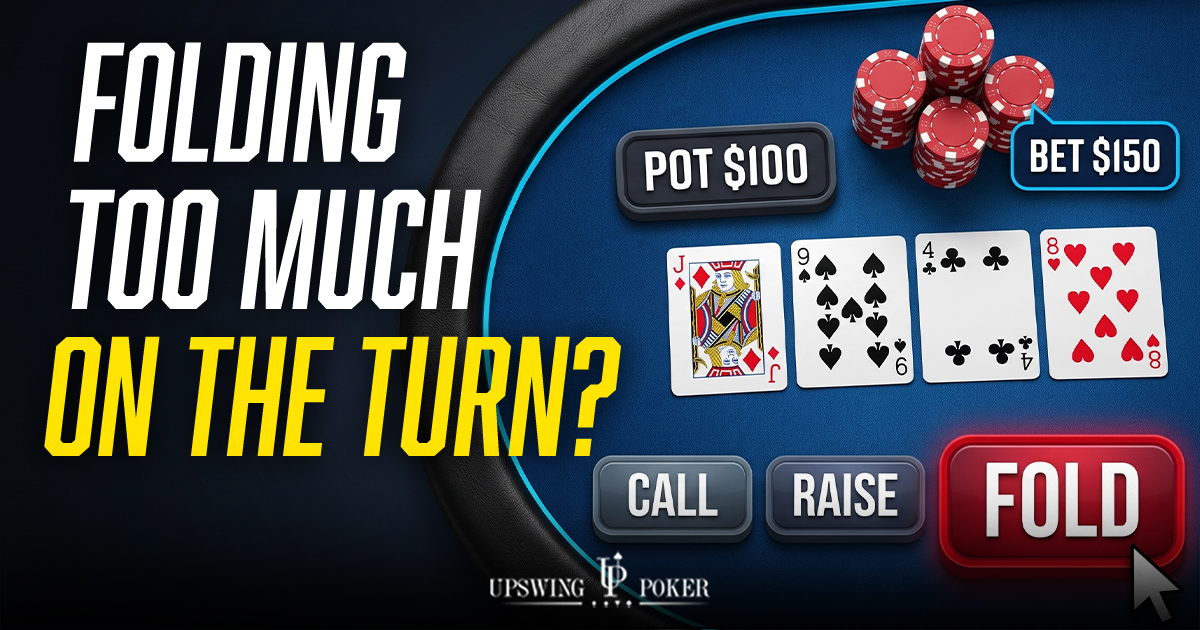
Tim Jenkins explains how to face turn continuation bets from the big blind in his Upswing Lab 2.0 video, according to the article. He starts by looking at which turn cards favor the player and which favor the opponent.
Jenkins says that when a turn improves your range much more than your opponent's, leading (donking) can make sense. A turn that pairs the middle card after a check-call of a large flop c-bet is one example he gives. In that spot, you often have many middle pairs, and few of your opponent's c-bet range contains them.
The article also says turns that improve your range can justify check-raising. On a Jd 9s 4c flop with an 8h turn, QT and T7 make straights and J8 and 98 make two pair. The article cautions that the opponent can also hold QT, so both players' likely hands need to be considered.
Jenkins warns against assuming every big turn bet means two pair or better. A strong opponent may value-bet thinly with one pair, and hands that beat some of those value bets should generally continue against a well-constructed range.
According to Jenkins, the turn is a spot where you rarely want to overfold relative to minimum defense frequency (MDF). The article notes that on the flop, the big blind can justifiably fold more often